

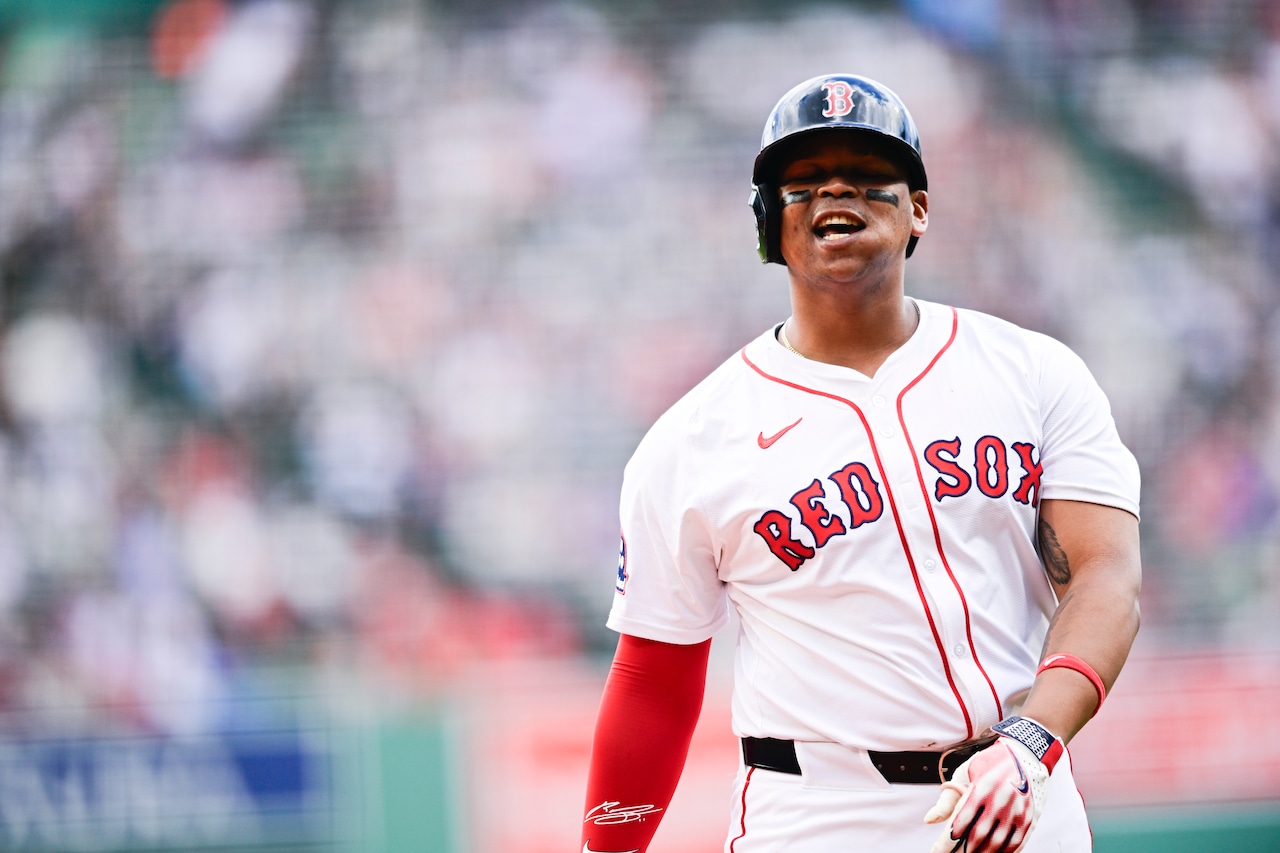
With a shutout victory Thursday afternoon, enabling them to win their series with the Texas Rangers and get back over the .500 mark, the Red Sox probably thought they were headed for a proverbial “happy flight” to Kansas City.
Think again.
Instead, after nearly a week of studiously avoiding the media, Rafael Devers relented and unsurprisingly, was asked his thoughts about moving to first place to fill the void left by the injured Triston Casas.
Devers didn’t hold back. And now, a quarter of the way through the season, the Red Sox have a gigantic mess on their hands with a story that’s not going away any time soon.
And they still don’t have an available solution for first base.
Some thoughts on the main characters involved, where there’s plenty of blame to go around:
Rafael Devers:
It’s not a good look when the face of your franchise responds to a request to try a new position like he was being told to go outside and play in traffic.
As the player who is both the longest-tenured and owner of the largest contract in team history, Devers is behaving like a seasonal, short-term employee.
He seemed not only disinterested in trying first base, but completely outraged by the request.
He also made the point that “the relationship that I have with my teammates is great,” and that, frankly, may be a stretch. I find it hard to believe that some teammates in the clubhouse aren’t questioning Devers’ level of commitment.
The team has an obvious need at first, with no other options on the current roster. Would shifting to first base represent a challenge? Of course. But it’s not unprecedented to move from one corner of the infield to the other, and in theory at least, Devers should be able to make that transition.
Looking for a current star player willing to do what’s best for his team? How about Mookie Betts, who, over the last three seasons, has moved from the outfield to the infield because the Dodgers had some needs after injuries struck.
In Philadelphia, Bryce Harper consented to moving from the outfield to first base — initially to get back on the field sooner following Tommy John surgery. But once there, he agreed to remain there. It happens.
The fact is, players willingly move positions all the time. Most don’t respond incredulously, as Devers did.
It’s a little disingenuous for to him to suggest that “they’re going back on (their word).” The Red Sox asked him to move to DH in spring training, not knowing, naturally, that Casas was going to suffer a torn patellar tendon five weeks into the season.
Now that the injury has happened, Devers is the best option to take over the position that became open due to unforeseen circumstances. That shouldn’t be too hard to process.
Moreover, his assertion “They can’t expect me to play every position out there,” is a little melodramatic, as is his hypothetical speculation that they’ll soon ask him to play the outfield.
Devers was the team’s third baseman. He was moved there to DH, which isn’t a position, but a role. It requires no defensive contributions. And now they’d like him to help them out at first base, where a teammate is lost for the season.
As for the outfield request? I’m pretty confident that won’t be made anytime soon.
For the past week, Devers has made every effort to avoid the media, presumably to avoid being asked about first base by reporters. For the 50-minute pregame period in which the media is allowed access to the clubhouse, Devers has been almost invisible, and postgame, he’s dressed quickly and exited.
Even Thursday afternoon, he initially expressed an unwillingness to take questions postgame before being convinced otherwise by members of the media relations staff. When he finally spoke, some lingering bitterness toward the team resurfaced.
Devers clearly feels disrespected by the organization, but I suspect his primary beef hasn’t been publicly disclosed: Over the winter, as the Red Sox pursued a trade for Nolan Arenado and contemplated signing free agent Alex Bregman, the Red Sox repeatedly assured Devers that such talk was merely media speculation.
It was far more than that, of course, as demonstrated by their signing of Bregman the week camp began. Given that history, it’s not hard to understand why an air of mistrust exists toward team officials.
Craig Breslow:
It’s worth remembering that Breslow inherited both Devers and his contract. Alex Cora made that point in spring training in a roundabout way when he pointed out that any promises made about remaining at third base for the duration of his Red Sox career came from the previous front office and chief baseball officer Chaim Bloom, and thus, were null and void.
I point this out because some baseball executives don’t always feel a level of attachment to players they didn’t acquire or sign.
Breslow did the logical thing here in asking Devers to try first base. Having Devers at first base would solve a number of issues, not the least of which involved potentially opening a spot for Masataka Yoshida at DH, or, perhaps, Roman Anthony — at least in the short term.
You can criticize Breslow for not having a suitable first base replacement at Triple A or in reserve in Boston but that ignores the fact that teams can’t have adequate, proven depth for every position on the field. Even if the Sox had signed, say, Dom Smith and assigned him to Worcester, would anybody be excited about those prospects for the next four and a half months? There are limits to having ready-made reinforcements for every conceivable outcome.
Still, Breslow is guilty of not doing a better job communicating with Devers last offseason, when he essentially told him not to pay attention to talk that the Sox were in the market for an upgrade at third.
That might have been a tough conversation to have, but in the long run, a more honest and direct talk would have served everyone better. It’s clear that Devers no longer trusts the front office.
Here’s what I found fascinating about Breslow’s request to Devers: that he himself made it, and not Alex Cora.
Ordinarily, communication with a player over an on-field switch would be handled by the manager. If it’s contractual, or in relation to a trade or something, then it’s appropriate to have someone from Baseball Operations handle the conversation.
But a talk about a new position or directly relating to a player’s role in the everyday lineup? That would typically be handled by the manager.
Did Cora decline to have the conversation with Devers? Or did Breslow assume the responsibility himself? And if so, why?
To date, Breslow and Cora appear to have had a good working relationship. It’s no secret that Cora clashed with Bloom, with the former believing that the latter didn’t do enough in 2022 and 2023 to enhance the roster at the deadline.
But no such schism has been detected between Breslow and Cora. Indeed, Cora made no secret of his desire for the team to sign Bregman over the winter, and Breslow eventually worked out the deal to bring the veteran infielder to Boston, a move which has worked out spectacularly well.
Is this the first crack in the relationship between the manager and the CBO?
Alex Cora:
A large part of Cora’s appeal since he became manager after the 2017 season has been his ability to relate to his players. That was evident in the Netflix documentary, where that skill set was on full display in his discussions with a homesick (and underperforming) Brayan Bello.
Cora can speak the language of Spanish-speaking players and understands their challenges, since, he, too, was once of them.
From the outside, it had appeared that Cora had done a nice job smoothing over the discontent Devers felt over his position change in the spring. It was obvious when Devers spoke in March that he was displeased with the switch to DH, but agreed to tolerate it.
And when Devers began the year in abysmal fashion, failing to get a hit in his first 19 at-bats while striking out 15 times, it was Cora who publicly — and presumably privately — expressed full confidence in Devers and his ability to figure things out at the plate.
Sure enough, Devers soon rebounded.
But apparently, the brokered peace didn’t last long. When Breslow approached Devers about playing first, it stirred up the resentment Devers had felt back in February.
Since the injury to Casas, Cora has steadfastly rejected the notion of having Devers take over at first. It’s unclear whether he was being protective of the player, or knowing that Devers had rejected the request, understood that the point was moot.
Managers often find themselves at cross-purposes. Yes, they’re team employees and ultimately have to answer to their superiors in management. But they also have close relationships with their players and often serve as a buffer between player and management or player and media members.
In retrospect, it’s clear that Cora felt caught in-between his allegiance to the players he must lead and the executives who oversee the roster construction of the club.
There’s also the clubhouse over which he presides. In recent days, there were growing whispers that some veterans on the team were puzzled by the team’s approach with Devers.
When Cora said he wasn’t going to ask Devers to move from DH to first base, it seemed to some that the message was: “We’re waiting for him to come to us.” In that way, it would appear that idea was that of Devers, a win-win situation for everyone.
But a few veterans, unaware that Devers had already rejected Breslow’s overture, may have thought that the club was being too passive, too deferential in its dealings with Devers.
Now that the backstory is public, that’s narrative will go away. But it’s worth wondering whether the Cora-Devers relationship has been damaged by the public disclosure.
Two things are undeniably true: One, there are still hard feelings from the debacle in February and those aren’t likely to go away anytime soon. And two, the Red Sox still don’t have a suitable replacement plan at first, and the most obvious in-house option is no longer on the table.