

For the third time in 2025, several planets are about to line up in the night sky near the end of February.
Saturn, Mercury, Neptune, Venus, Uranus, Jupiter and Mars are set to appear in the night sky on Feb. 28, according to StarWalk, the website for the star-tracking app on mobile devices.
NASA describes this type of alignment – in a term used by both professional and amateur astronomers – as a planetary parade. It’s common to see two or three planets in the night sky, but occasionally four or more glow in the skies above, usually visible to the naked eye.
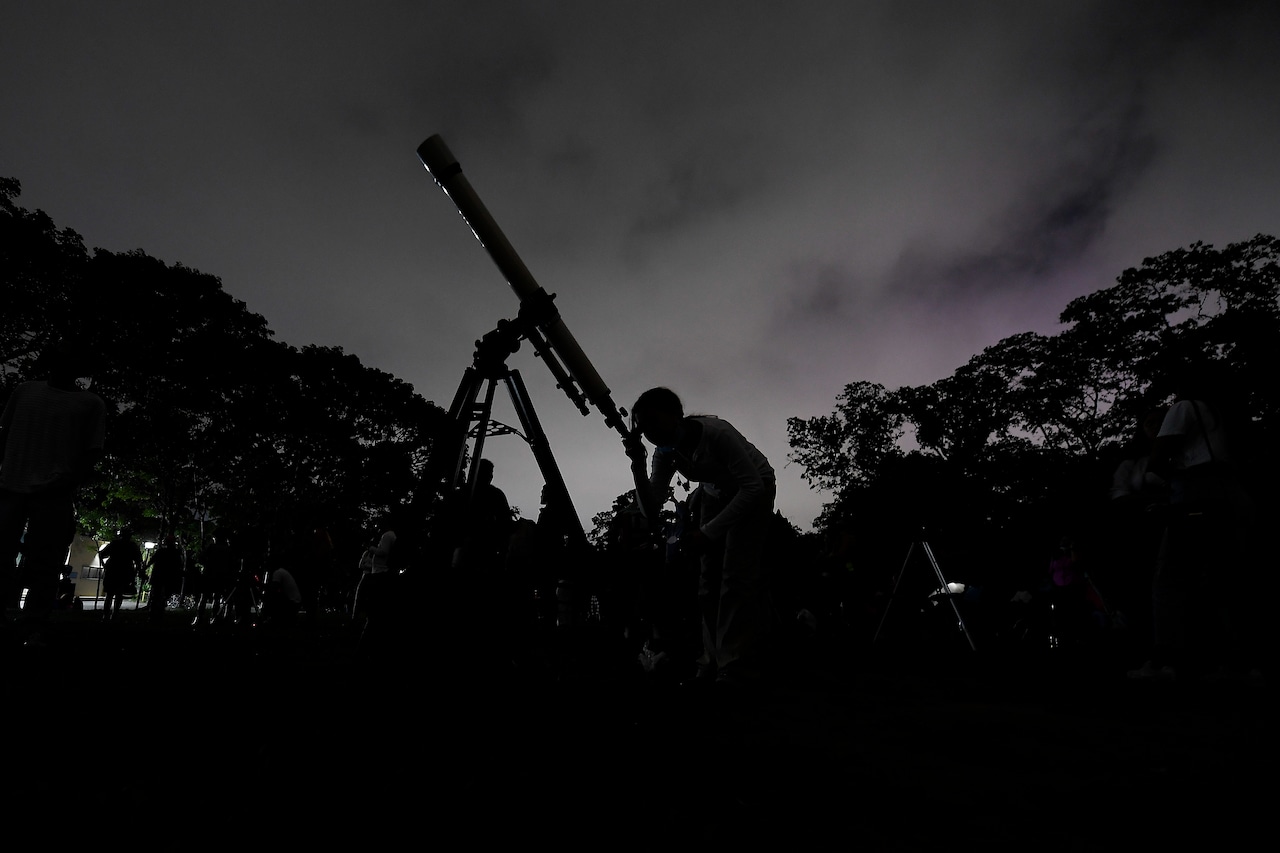
However, some of the planets technically visible during this event will need to be seen through binoculars or a small telescope, StarWalk wrote. Two of the three hardest-to-see planets are Uranus and Neptune, the last two planets in the solar system.
The third planet, and the hardest to see, will be Saturn, astronomers said. In the days after its conjunction with Mercury, Saturn’s brightness will become dimmer, reaching a magnitude of +1.1.
A celestial object’s stellar magnitude describes how bright that object looks in the night sky, with the brightest stars being seen at a magnitude of 1, EarthSky wrote. Objects with a negative magnitude appear much brighter without the need for a telescope, according to NASA.
“Although it’s usually bright enough to be easily visible in the night sky, this time, it’s very close to the sun,“ StarWalk wrote. ”To see the planet in [the direction of the constellation] Aquarius, find a time when the sun is already below the horizon, but Saturn hasn’t yet set in your location.”
While bright, Mercury is also going to be seen near Saturn, in the western sky, but the sun’s brightness could hurt the chances of seeing it, according to StarWalk.
Mars should be at the highest point in the night sky, seen in the direction of the constellation Gemini, the space website stated. Jupiter should be visible in the constellation Taurus, while Uranus should be spotted in the constellation Aries. Venus and Neptune can be seen in the constellation Pisces.
The night of the alignment is also set to coincide with a new moon, which should make it easier to see the fainter planets.